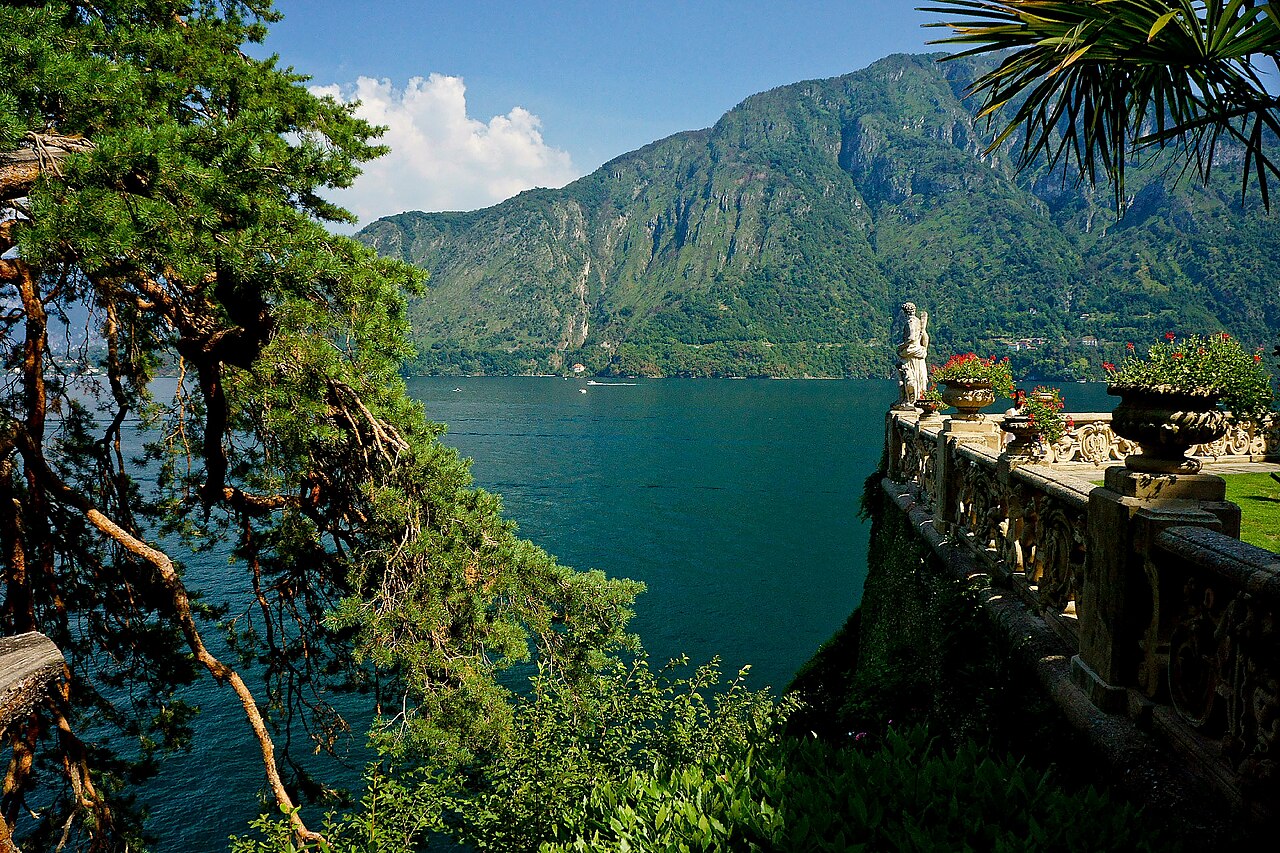
Villa del Balbianello rises on Dosso d'Avedo, a small wooded peninsula that pushes into the western shore of Lake Como just south of Lenno. The building was commissioned in 1787 by Cardinal Angelo Maria Durini, who acquired the site of an abandoned Franciscan monastery and re-imagined it as an enlightenment-era retreat for poets and intellectuals. The two surviving bell towers of the old monastery were absorbed into the new design as the chapel that still flanks the loggia today.
Across the nineteenth and early twentieth centuries the property passed through several aristocratic hands, slowly accumulating the layered character that visitors recognise now — the gardens were terraced, the boathouse rebuilt, and the famous twin-arched loggia perfected as a frame for the lake. By the post-war years, however, the villa was running down. Its rescue came from an unexpected figure: the Italian explorer and businessman Guido Monzino.
Monzino bought the villa in 1974 and spent fifteen years restoring it in meticulous detail. He filled the interior with the maps, sledges, ice axes and field equipment of his own expeditions, including the first Italian ascent of Everest in 1973 and his polar crossings of the 1970s. When he died in 1988, he bequeathed the entire property — building, gardens, collections and library — to the Fondo per l'Ambiente Italiano (FAI), Italy's national trust, with the explicit wish that it remain open to the public exactly as he had left it.
The result is unusual. Most lake villas are essentially gardens with a house attached. Balbianello is the opposite: a working archive of one twentieth-century life — explorer, collector, host — wrapped in a garden that was always designed as a stage set rather than a botanical showcase. It is this combination, as much as the views, that gives the place its quiet intensity.